
Shore ceased all production operations in 2012 and their products are no longer available. CCSi continues to support Shore equipment in regard to service, calibration and ISO/IEC 17025 certification.
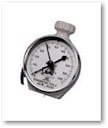
The Shore® Round Style durometer was introduced in 1944. They have been the most widely used instruments throughout the world for the hardness testing of cellular, soft and hard rubber and plastic materials. They are small enough to be carried in the pocket, yet rugged enough to operate in the most hostile environment.
The Shore® Round Style durometer was designed to satisfy industry needs for a durometer with a scale graduated in increments of one rather than the five of the Quadrant Style durometer.
Its evolution has produced a most accurate analog durometer. The Round Style durometers may be manually applied, or for better repeatability and accuracy, mounted on a Shore® operating stand.
Please refer to the Shore® Durometer Selection Guide for an explanation of Shore® model, type and scale designations, as well to assure the proper selection of the Shore® durometer to suit your specific application.
Ask for Price
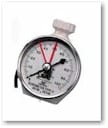
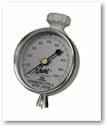
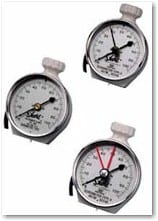

The maximum reading indicator design is convenient in applications where the maximum reading obtained may not be easily or immediately observed. It is also useful in eliminating errors caused by focal parallax, even in laboratory situations.
The maximum reading indicator follows the indicating pointer and maintains its position after the maximum result is attained until it is reset by the operator. The maximum reading indicator imposes very little resistance and does not appreciably effect the determinations attained.
However, the coefficient of drag imposed is such that this option is not available on durometer types having a spring force of 113 grams or less.
The tolerance indicator design is ideally suited for applications where the test determinations are within a range of acceptability.
The bright red, easily visible, tolerance indicators may be adjusted to the desired high—low range, representing user defined upper and lower control limits.
The tolerance indicators improve speed, accuracy, and precision while greatly reduce operator error, especially in high volume testing situations.
The tolerance indicators are “passive”, in that they do not contact the indicating hand, and do not influence the durometer operation or test determinations.
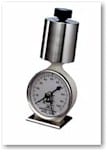
The Constant Load Option incorporates a large two inch square presser foot and a mass which can be detached to accommodate storage and mounting on an operating stand.
The Half Inch Foot Option employs an extended half inch diameter presser foot to accommodate specimens that may not ordinarily be tested with the standard rectangular presser foot configuration.
- Rugged die cast aluminum frame;
- Stainless steel coil mainspring;
- Glass dial face;
- Durable TFE (Teflon®) bushings;
- Integral indentor guard;
- Precision independent movement which allows critical span adjustment;
- Rugged vinyl covered steel storage case;
- Silicone rubber test block.
| Types: | A, B, C, D, DO, O, OO, OOO—S, & T |
| Presser Foot: | 35 x 19 mm (1.375 x 0.75 inch) |
| Pointer Sweep: | 265º |
| Scale: | 0 — 100, 1 Point Graduations |
| Weight: | 220 g |
| Standards: | ASTM D2240 | ISO 868 & ISO 7619 | DIN 53505 (A & D) | JIS K6253 (A & C) | Asker C / SRIS0101 |
Note: DIN & JIS Types are special orders.
Certificate of calibration is included.
| Part Number | Model | Scale | Description |
| 407030000 | XA | A | Standard Models |
| 407030100 | XB | B | Standard Models |
| 407030200 | XC | C | Standard Models |
| 407030300 | XD | D | Standard Models |
| 407030400 | XDO | DO | Standard Models |
| 407030500 | XO | O | Standard Models |
| 407030600 | XOO | OO | Standard Models |
| 407030800 | XOOO-S | OOO-S | Standard Models |
| 407030700 | XT | T1 | Concave Contact Foot |
| 407040000 | XAMX | A | Maximum Indicator (MX) |
| 407040200 | XCMX | C | Maximum Indicator (MX) |
| 407040300 | XDMX | D | Maximum Indicator (MX) |
| 407040400 | XDOMX | DO | Maximum Indicator (MX) |
| 407040500 | XOMX | O | Maximum Indicator (MX) |
| 407041000 | XACL | A | Constant Load (CL) |
| 407041100 | XACLMX | A | Constant Load (CL) |
| 407041200 | XATH | A | Tolerance Indicator |
| 407041300 | XAHAF | A | Half Inch Contact Foot (HAF) |
| 407041400 | XAMXHAF | A | Half Inch Contact Foot (HAF) |
| 407041900 | XDHAF | D | Half Inch Contact Foot (HAF) |
| 407042000 | XDMXHAF | D | Half Inch Contact Foot (HAF) |
| 407042200 | XDOMXHAF | DO | Half Inch Contact Foot (HAF) |
| 407042300 | XOHAF | O | Half Inch Contact Foot (HAF) |
| 407042400 | XOMXHAF | O | Half Inch Contact Foot (HAF) |
| 407042500 | XOOHAF | OO | Half Inch Contact Foot (HAF) |
1 Shore® Type T is not yet ASTM approved.
| Part Number | Model | Scale | Description |
| 407042600 | JXA | JIS A | Standard Model |
| 407042700 | JXAMX | JIS A | Maximum Indicator |
| 407042800 | JXAHAF | JIS A | Half Inch Contact Foot |
| 407042900 | JXAMXHAF | JIS A | Maximum Indicator & Half Inch Contact Foot |
| 407043000 | JXC | JIS C | Standard Model |
| 407043100 | JXCMX | JIS C | Maximum Indicator |
| Part Number | Model | Scale | Description |
| 405020000 | FWC | Asker C | Standard Model |
| 405030000 | FWCHAF | Asker C | Half Inch Contact Foot |
standard durometer, round durometer, Shore durometer, Shore durometers, Shore hardness, Shore, Shore A, Shore D, hardness, rubber hardness, plastic, plastic hardness, indentation hardness, ebonite, ebonite hardness, rubber hardness testing, rubber testing, hardness testing, durometer hardness, testing, ASTM D2240, D2240, ASTM D1957, ISO 868, ISO 7619, JIS K6253, JIS K6251, JIS K6252, JIS K 6253, JIS K6254, JIS K6255, JIS K6256, JIS K6257, JIS K6258, JIS K6259, JIS K6260, DIN 53505, DIN 53 505, CNS, K6898, BS 903, BS 2782, BS ISO 21509, BS EN ISO 868, GB/T 10807, Asker, Asker C, SRIS0101, MIL-STD-45622A, MIL-I-45208A, MIL-STD-120, ERDEC, TRDEC, NAVSWC, DREA, 83.060, 83.080.01.